
Shah Jahan and Mumtaz Mahal: The Real Story Behind the Taj Mahal
By IWIS Global · Published 15 October 2026
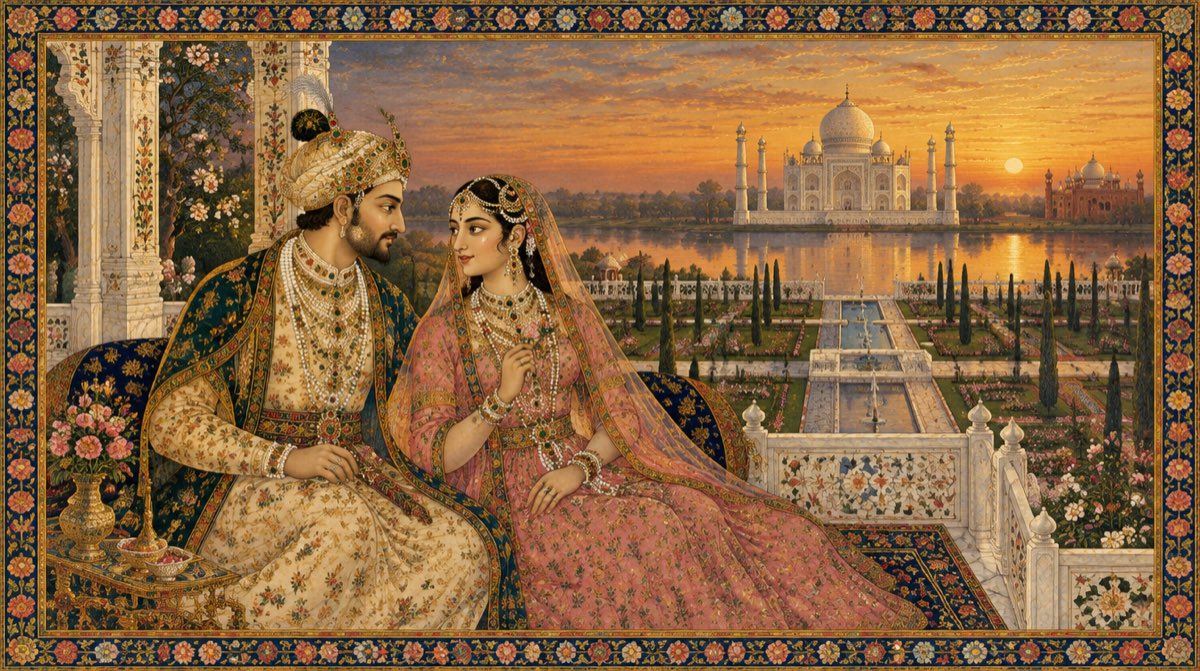
The Taj Mahal is the tomb Emperor Shah Jahan built for his wife Mumtaz Mahal, who died in 1631 giving birth to their fourteenth child. It was the grief of a ruler, but also a statement of imperial power: a garden of paradise on the banks of the Yamuna River in Agra, designed by Ustad Ahmad Lahori and built over some 16 years by craftsmen from across the Mughal Empire, Central Asia and Iran. This is the real story behind the world's most famous love monument: what is documented, what is legend, and what to look for when you stand in front of it.
Shah Jahan and Mumtaz Mahal: quick facts
| Who | Emperor Shah Jahan (born Prince Khurram) and Empress Mumtaz Mahal (born Arjumand Banu Begum; her title means "Chosen One of the Palace") |
| Mumtaz Mahal born | 1593 |
| Betrothed / married | Betrothed in 1607, married in 1612 |
| Mumtaz Mahal died | 17 June 1631, Burhanpur, during the birth of her 14th child |
| Taj Mahal built | Construction began in 1632; tomb completed by 1648; gateway, mosque and courtyard finished by 1653 |
| Chief architect | Ustad Ahmad Lahori, named as main architect on UNESCO's World Heritage listing |
| Where | Agra, Uttar Pradesh, on the right bank of the Yamuna |
| Status | UNESCO World Heritage Site since 1983 |
Who was Mumtaz Mahal?
Mumtaz Mahal was born Arjumand Banu Begum in 1593 into the highest circle of the Mughal court. Her father, Asaf Khan, was a powerful noble and the brother of Empress Nur Jahan, the wife of Emperor Jahangir. Her grandfather, Mirza Ghiyas Beg, was Jahangir's chief minister, and his tomb in Agra, Itimad-ud-Daulah, is often nicknamed the "Baby Taj" because its marble inlay work foreshadows the Taj Mahal.
At about 14 she was betrothed to Prince Khurram, the future Shah Jahan. The couple waited five years, and a wedding date picked by court astrologers brought them together in 1612. She is best known by the title Mumtaz Mahal, "the Chosen One of the Palace", and when Khurram became emperor in 1628 she became empress. She is recorded as keeping the imperial seal. Shah Jahan had other wives, as Mughal custom allowed, but chroniclers agree she was the one he trusted most.
The Shah Jahan and Mumtaz Mahal love story
Their marriage was a working partnership as much as a romance. Mumtaz Mahal travelled with Shah Jahan on military campaigns, including long journeys into the Deccan, rather than staying in the capital. She bore 14 children over 19 years. Among them were Jahanara Begum, who later became the first lady of the court, Dara Shikoh, the scholarly heir, and Aurangzeb, who would one day take the throne from his father.
That devotion is the heart of the Taj Mahal love story. It is also why the building is read as a monument to one marriage, not a victory monument or a palace. Shah Jahan commissioned grand works across his reign, but only one became a tomb for a wife.
How did Mumtaz Mahal die?
Mumtaz Mahal died on 17 June 1631 in Burhanpur, in the Deccan (today in Madhya Pradesh), after a labour of around 30 hours, giving birth to her 14th child, a daughter named Gauhar Ara Begum. Shah Jahan was in Burhanpur on campaign at the time.
Her body was first buried in the walled garden of Zainabad on the bank of the Tapti River. In December 1631 it was carried to Agra in a golden casket, escorted by her son Shah Shuja, and later laid in the Taj Mahal. Accounts of the emperor's grief describe a long period of mourning at court. Her eldest daughter Jahanara is credited with gradually drawing her father back into public life.
Why was the Taj Mahal built?
The simple answer is that Shah Jahan wanted a tomb worthy of Mumtaz Mahal. The fuller answer has three parts.
- Grief and devotion. The emperor wanted to honour his wife in a way no earlier Mughal tomb had.
- A vision of paradise. The tomb sits at the end of a Persian-style garden divided into four quarters (a charbagh) with water channels. Mughal builders meant the whole complex to echo the gardens of paradise described in the Quran.
- A statement of empire. In the 1630s the Mughal Empire was at its height. A tomb on this scale, in white marble, showed the dynasty's wealth and taste to the world.
Mughal court histories called the building the Rauza-i-Munavvara, the "illumined tomb". The name "Taj Mahal" is generally explained as coming from her title, Mumtaz Mahal.
Who built the Taj Mahal, and when?
Construction began in 1632 on land by the Yamuna. UNESCO's listing records that the tomb was finished in 1648, and that the mosque, the guest house, the main gateway and the outer courtyard were completed by 1653.
Who designed it? UNESCO names Ustad Ahmad Lahori as the main architect. Masons, stone-cutters, inlayers, carvers, painters, calligraphers and dome builders were gathered from across the empire and from Central Asia and Iran. No single genius built the Taj: it was the work of thousands of specialists.
What makes the architecture special?
- The tomb is not in the middle of the garden but at its far end, beside the river. That placement gives the view from the gateway depth and perspective, and UNESCO singles it out as an innovation.
- The white marble is inlaid with precious and semi-precious stones in flower patterns, a technique called pietra dura.
- Quranic verses in Arabic calligraphy frame the arches.
- The four minarets at the corners give the monument its three-dimensional presence. The red sandstone mosque and the matching guest house on either side set off the marble.
Good to know: the cenotaphs you see inside the main chamber are symbolic. The real graves lie in the crypt below, a practice common in imperial Mughal tombs.
What happened to Shah Jahan after the Taj Mahal?
In 1658 Shah Jahan fell seriously ill and his sons fought for the throne. Aurangzeb won, and he kept his father under guard in the Agra Fort for roughly eight years. Shah Jahan died there on 22 January 1666. From the fort's Musamman Burj, a marble tower, the old emperor could look along the river at the Taj Mahal.
He was buried beside Mumtaz Mahal in the crypt. His cenotaph is larger than hers and sits to the west of hers, the only break in the Taj Mahal's otherwise perfect symmetry. UNESCO's description notes it was installed more than thirty years after hers.
Taj Mahal myths: what is not true
- The Black Taj Mahal. The story of a second tomb in black marble for Shah Jahan himself, across the river, is a legend. There is no evidence he planned one. The site opposite, Mehtab Bagh, is the Mughal garden that frames the best sunset view of the Taj Mahal today.
- Hands cut off. The tale that the craftsmen's hands were cut off to stop them building another Taj Mahal has no support in historical sources.
See Shah Jahan and Mumtaz Mahal's story in person
If you visit Agra, the story is easier to follow in this order:
- Itimad-ud-Daulah, the "Baby Taj", for her grandfather's tomb and the first marble inlay.
- The Taj Mahal, for the gateway, the garden, the calligraphy and the crypt cenotaphs.
- Agra Fort, for Shah Jahan's final years and the Musamman Burj view.
- Mehtab Bagh, for the Taj Mahal across the river at sunset.
The Taj Mahal is closed on Fridays, and opens 30 minutes before sunrise and closes 30 minutes before sunset. Our guide to the best time to visit the Taj Mahal explains the seasons, and the ticket price guide has current entry fees, so they are not repeated here.
Booking a Taj Mahal tour from Delhi? A private guide is the best way to hear this story at the places where it happened.
- For quiet light and fewer people, a Taj Mahal sunrise tour from Delhi.
- For a full day by car, the same-day Agra tour from Delhi, covering the Taj Mahal and Agra Fort.
- Around a full moon, the moonlight night viewing tour. Night viewing runs only on set dates.
- All options are on the tours page. If you are still deciding, read is a sunrise tour worth it and our overview of Taj Mahal tour packages from Delhi.
FAQs about Shah Jahan, Mumtaz Mahal and the Taj Mahal
Why did Shah Jahan build the Taj Mahal? He built it as a tomb for his wife Mumtaz Mahal, who died in 1631. It also expressed the power and taste of the Mughal Empire at its height.
How did Mumtaz Mahal die? She died on 17 June 1631 in Burhanpur, during the birth of her 14th child, Gauhar Ara Begum, after a long labour.
How long did it take to build the Taj Mahal? Construction began in 1632. The tomb was complete by 1648 and the whole complex by 1653, so about 16 to 21 years depending on what you count.
Who designed the Taj Mahal? UNESCO names Ustad Ahmad Lahori as the main architect, working with artisans from across the empire, Central Asia and Iran.
Is Shah Jahan buried in the Taj Mahal? Yes. He lies beside Mumtaz Mahal in the crypt, with a larger cenotaph placed next to hers.
Was Shah Jahan imprisoned? Yes. After Aurangzeb took power in 1658, Shah Jahan was held in the Agra Fort until he died in 1666.
What is the Taj Mahal's UNESCO status? It is a UNESCO World Heritage Site, inscribed in 1983, and the monument is managed by the Archaeological Survey of India.
Is the Black Taj Mahal real? No. The idea of a matching black marble tomb is a legend with no supporting evidence.
Which day is the Taj Mahal closed? Fridays. Opening hours follow sunrise and sunset, so check them against the season before you plan your Agra day trip.
Can I visit the Taj Mahal in one day from Delhi? Yes. A same-day private tour by car covers the Taj Mahal and Agra Fort, and most travellers find one day enough. See our guide on whether one day is enough.
Sources
Dates and architecture are taken from the UNESCO World Heritage listing for the Taj Mahal and the Archaeological Survey of India's pages on Mumtaz Mahal. Where chronicles differ or a story is a legend, we say so above.
More from the blog
- Did Shah Jahan Build the Taj Mahal After Mumtaz's Death? Yes: Mumtaz Mahal died in 1631 and the Taj Mahal was begun in 1632. The full timeline, from her first grave in Burhanpur to the finished tomb in 1653.
- What Is the Real Story Behind the Taj Mahal? 10 Myths vs Facts The real story behind the Taj Mahal, myth by myth: the temple claim, the 22 locked rooms, the Black Taj, the craftsmen's hands and more, checked against the records.
- Agra Travel Glossary: 40 Terms to Know Before You Go A plain-English Agra travel glossary: 40 terms, places and rules, from Taj Mahal tickets and Friday closures to UNESCO sites, trains and food.
Keep reading
- How to Avoid Taj Mahal Scams (2026) The scams that catch visitors between Delhi and the Taj Mahal, from fake ticket sites to 'skip the line' guides, and how to check any operator.
- Taj Mahal Opening Hours and Friday Closure The Taj Mahal opens 30 minutes before sunrise and is closed every Friday. Opening times by month, ticket counters and gates, from ASI's own page.
- Delhi to Agra in a Day: Car or Train? Delhi to Agra in one day: by car (about 3 hours each way) or the Gatimaan Express (1 hr 40 min)? Times, costs and trade-offs compared.