
Did Shah Jahan Build the Taj Mahal After Mumtaz's Death?
By IWIS Global · Published 26 October 2026
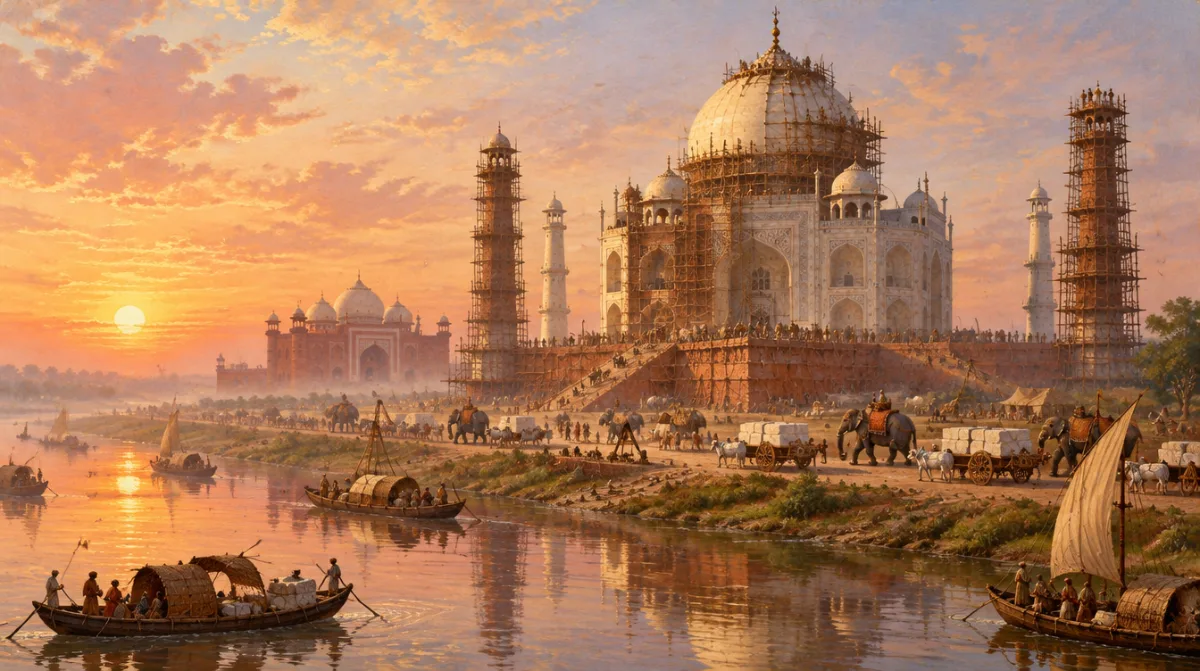
Yes. Shah Jahan began the Taj Mahal after Mumtaz Mahal died. She died on 17 June 1631 in Burhanpur, in the Deccan, giving birth to their fourteenth child. The emperor commissioned her tomb that same year, work on the site in Agra began in 1632, the mausoleum was finished in 1648 and the whole complex, with its gateway, mosque and gardens, by 1653. Nothing was built while she was alive. Here is the timeline, from the night she died to the day the last stone was set.
See the timeline for yourself. On our private Taj Mahal tours from Delhi, your guide shows you the spot in the garden where Mumtaz Mahal was first laid to rest, the crypt where she lies today, and the Agra Fort tower where Shah Jahan spent his last years. See the tours →
The short timeline
| Date | What happened |
|---|---|
| 17 June 1631 | Mumtaz Mahal dies in Burhanpur after giving birth to Gauhar Ara Begum. She is buried there in the Zainabad garden on the Tapti River. |
| 1631 | Shah Jahan commissions a tomb for her in Agra. |
| December 1631 | Her body leaves Burhanpur for Agra in a funeral procession led by her son, Prince Shah Shuja. |
| 1632 | Work begins on the riverside site in Agra. She is buried for a time on the site itself while the tomb rises. |
| 1643 | An anniversary ceremony (urs) for her death is held at the partly built tomb. |
| 1648 | The mausoleum is finished. |
| 1653 | The gateway, mosque, guest house and outer courtyards are complete. |
| 1666 | Shah Jahan dies in the Agra Fort and is buried beside her in the crypt. |
Sources for the dates are listed at the end of this post.
Where was Mumtaz Mahal buried before the Taj Mahal?
Mumtaz Mahal died far from Agra. Shah Jahan was on campaign in the Deccan and she travelled with him, as she often did. Her body was first buried in Zainabad, a walled garden on the bank of the Tapti River in Burhanpur.
About six months later, in December 1631, her remains were exhumed and carried some 700 kilometres north to Agra in a golden casket, escorted by Prince Shah Shuja. In Agra she was buried for a time in the grounds of the new site. A marker in the north-western part of the Taj Mahal garden is traditionally pointed out as the place of that temporary grave. She was then moved to the crypt beneath the main chamber, where she lies today.
Why did Shah Jahan choose that spot in Agra?
The land on the bank of the Yamuna, just south of the walled city of Agra, belonged to Raja Jai Singh of Amber. Shah Jahan acquired it in exchange for a large palace in the centre of Agra. The riverside site mattered: it allowed a tomb set at the end of a great garden, reflected in the river and visible from the Agra Fort upstream.
How long did it take to build?
- The tomb itself: about 16 years, from 1632 to 1648.
- The whole complex: about 21 years, to 1653.
- The workforce: more than 20,000 people, according to Britannica, including masons, stone-cutters, marble inlayers, calligraphers and dome builders from across the Mughal Empire, Central Asia and Iran.
The design is credited to Ustad Ahmad Lahori, whom UNESCO names as the main architect. Workers raised a huge brick scaffold around the tomb rather than a wooden one, and white marble was brought from Makrana in Rajasthan.
Did Shah Jahan plan the Taj Mahal before she died?
There is no evidence of it. The tomb was commissioned after her death, the land was acquired for it afterwards, and the court histories present it as a memorial to her. Mumtaz Mahal is recorded as taking an interest in riverside gardens in Agra, and some historians suggest this may have shaped the garden-tomb idea, but the building itself belongs entirely to the years after 1631.
What happened to Shah Jahan after the Taj Mahal was finished?
In 1658 Shah Jahan fell ill and his sons fought for the throne. Aurangzeb won and held his father in the Agra Fort until his death on 22 January 1666. From the fort's marble tower, the Musamman Burj, the old emperor could look down the river at the tomb he had built. He was buried beside Mumtaz Mahal. His cenotaph, added later and larger than hers, is the one thing that breaks the Taj Mahal's symmetry.
For the full love story, read Shah Jahan and Mumtaz Mahal: the real story behind the Taj Mahal. For the legends that grew up around the building, from the "Black Taj" to the craftsmen's hands, see What Is the Real Story Behind the Taj Mahal? 10 Myths vs Facts.
Seeing the story in Agra
- The Taj Mahal: the gateway, the garden with the temporary grave marker, and the cenotaphs above the crypt.
- The Agra Fort: the Musamman Burj, with its view of the Taj along the river.
- Mehtab Bagh: the garden across the Yamuna, aligned with the tomb, best at sunset.
The Taj Mahal is closed on Fridays. It opens 30 minutes before sunrise and closes 30 minutes before sunset. Current entry fees are in our Taj Mahal ticket price guide.
Coming from Delhi? The same-day Agra tour by car covers the Taj Mahal and the Agra Fort with your own guide. For the softest light and the smallest crowds, take the sunrise tour.
Frequently asked questions
Did Shah Jahan build the Taj Mahal after Mumtaz Mahal's death? Yes. She died in June 1631; he commissioned the tomb that year and work began in 1632.
How many years after her death was the Taj Mahal finished? The mausoleum was finished in 1648, 17 years after her death, and the full complex in 1653, 22 years after.
Where did Mumtaz Mahal die? In Burhanpur, in present-day Madhya Pradesh, while Shah Jahan was on campaign in the Deccan.
Where was Mumtaz Mahal buried first? In the Zainabad garden in Burhanpur. Her body was brought to Agra in December 1631 and buried on the Taj site before being placed in the crypt.
Who designed the Taj Mahal? UNESCO names Ustad Ahmad Lahori as the main architect.
Is Shah Jahan buried in the Taj Mahal? Yes, beside Mumtaz Mahal in the crypt. He died in 1666.
Sources
Dates of construction and the architect: the UNESCO World Heritage listing for the Taj Mahal. Mumtaz Mahal's dates and place of death: the official Taj Mahal website of Uttar Pradesh Tourism. Workforce: Britannica. The journey from Burhanpur: Live History India. The land exchange, the temporary grave and the 1643 ceremony: the Taj Mahal article on Wikipedia and the works it cites (Koch, The Complete Taj Mahal, 2006).
More from the blog
- Agra Travel Glossary: 40 Terms to Know Before You Go A plain-English Agra travel glossary: 40 terms, places and rules, from Taj Mahal tickets and Friday closures to UNESCO sites, trains and food.
- Diwali and the Taj Mahal: Festivals and Crowds in Agra Visiting the Taj Mahal around Diwali 2026: dates, whether it is open, crowd and smog patterns, other Agra festivals, and how to plan around them.
- What to Eat in Agra: Petha, Bedai-Jalebi, Chaat and Mughlai Food A food guide to Agra: petha, the bedai-jalebi breakfast, street chaat, dalmoth and Mughlai dinners, with what to order, when to go and how to eat safely.
Keep reading
- How to Avoid Taj Mahal Scams (2026) The scams that catch visitors between Delhi and the Taj Mahal, from fake ticket sites to 'skip the line' guides, and how to check any operator.
- Best Month to Visit the Taj Mahal November through February is coolest, but not always clearest. Month-by-month temperature, pollution pattern, and sunrise timing — not just 'winter is best.'
- Taj Mahal Opening Hours and Friday Closure The Taj Mahal opens 30 minutes before sunrise and is closed every Friday. Opening times by month, ticket counters and gates, from ASI's own page.