
Agra Fort: A Self-Guided Story, With Key Spots a Guide Will Show You
By IWIS Global · Published 15 October 2026
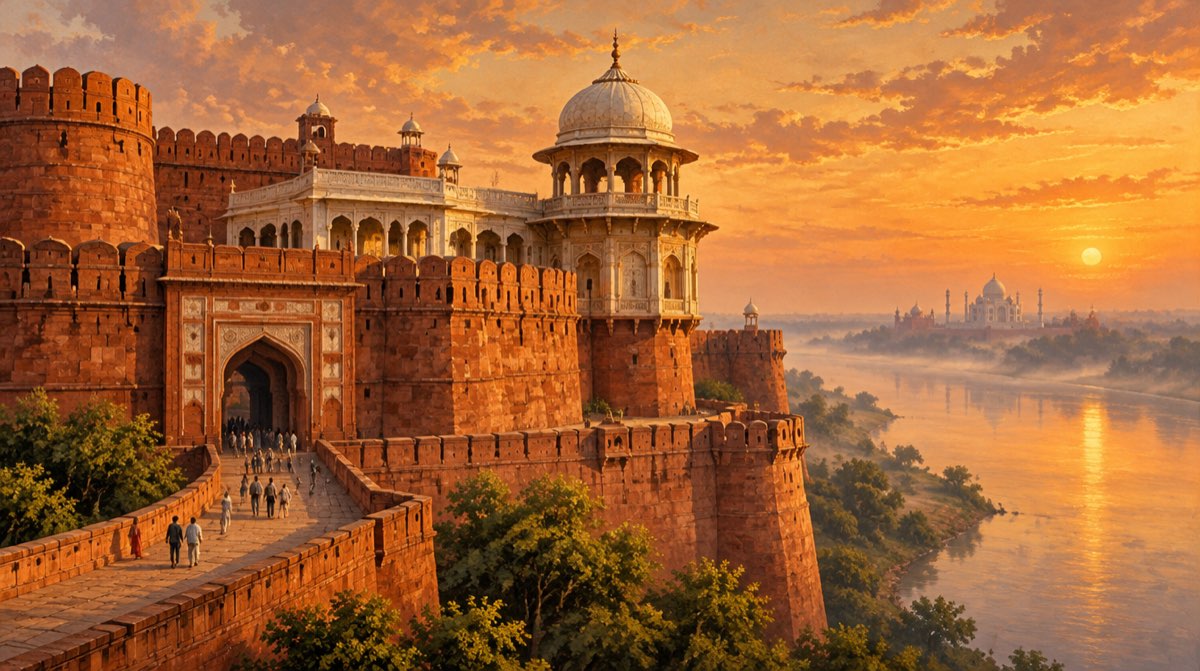
Agra Fort is easy to walk on your own, and it rewards a slow visit. The red sandstone fortress on the Yamuna was rebuilt by Emperor Akbar from 1565 to 1573, turned into a marble palace city by his grandson Shah Jahan, and became the place where Shah Jahan spent his last years as a prisoner. This self-guided story takes you through the fort in a sensible order, explains what you are looking at, and flags the key spots where a guide adds the most: the stories, the carved details and the small things that signs do not explain.
Agra Fort at a glance
| Also called | Red Fort of Agra, Qila-i-Akbari ("Akbar's Fort") |
| Rebuilt in red sandstone | 1565 to 1573 under Emperor Akbar, on the site of an older brick fort known as Badalgarh |
| Marble palaces added | Under Shah Jahan, from 1628 |
| Size | A semi-circular plan with walls about 2.5 km long, one straight side facing the Yamuna (UNESCO) |
| Status | UNESCO World Heritage Site since 1983 |
| Visitor entrance | Amar Singh Gate, on the south side |
| Hours | 6:00 AM to 6:00 PM, every day, including Fridays |
| Distance from the Taj Mahal | About 2.5 km, a short drive within Agra |
The story in five minutes
Akbar made Agra his capital in 1558 and moved into an older brick fort that was already in poor condition. In 1565 he ordered it rebuilt in red sandstone, with a brick core and a sandstone face, and the work took about eight years. Akbar's fort was a working fortress and a palace at once: gateways with bent entrances, a moat and a drawbridge, and living quarters inside.
Akbar's grandson Shah Jahan changed the look of the fort. From 1628 he replaced much of the older palace complex with white marble buildings: the Diwan-i-Am, the Diwan-i-Khas, the Khas Mahal, the Musamman Burj and the Moti Masjid. That is why the fort has two moods: strong red sandstone in the outer walls and early palaces, and pale, delicate marble in the riverside pavilions.
The fort also holds a painful chapter. When Shah Jahan fell ill in 1658, his sons fought over the throne and Aurangzeb won. He kept his father confined in the fort, in the Musamman Burj, until Shah Jahan died in 1666. The story of how Shah Jahan built the Taj Mahal for his wife, and ended his life looking at it from this fort, is told in Shah Jahan and Mumtaz Mahal: the real story behind the Taj Mahal. Read it first if you can: it makes Agra Fort feel like the second half of the same story.
Before you go: practical tips for a self-guided visit
- Entrance: the Amar Singh Gate is the only visitor entrance. The grander Delhi Gate on the west wall was the original formal entrance, but it is not open to visitors, and a large part of the fort is held by the Indian Army and closed to the public.
- Hours: open 6:00 AM to 6:00 PM every day. Because the Taj Mahal is closed on Fridays, Friday is a good day to put Agra Fort first.
- Tickets: buy them on ASI's official site or at the gate. Current fees are on our Agra Fort page, so they are not repeated here.
- Time: most visitors enjoy 90 minutes to two hours. Give yourself more if you like reading every inscription.
- Light: early morning and late afternoon are best. The red sandstone glows, and the white marble pavilions photograph well against it.
- Access changes: some interiors open and close for conservation or safety. Treat the list below as a guide to the main sights, and check signs and staff on the day.
- Beware of unofficial guides at the gate. If you want a guide, read our note on how to avoid Taj Mahal scams first.
A self-guided route through Agra Fort
This is a workable order, from the entrance to the river palaces and then the public halls. Signs and one-way arrows can change, so follow them where they differ.
1. Amar Singh Gate and the ramp
You enter through the Amar Singh Gate, on the south side. The outer gate was added in the 17th century during Aurangzeb's reign, when an extra defensive wall went up around Akbar's fortifications. Behind it is the older Akbari Gate. Notice the bent entrance: the path turns, so no army could charge straight in. Both main gates were originally protected by a moat and a drawbridge.
A guide adds: how the gates were defended, and the story behind the gate's popular name, which is linked to a Rajput soldier, Amar Singh Rathore.
2. Jahangiri Mahal and Jahangir's Hauz
This red sandstone palace is one of the earliest surviving buildings of Akbar's reign, and the largest residence still standing in the fort. It was built for his son Jahangir and served as the main women's quarters, home to Akbar's Rajput wives, including his chief consort Mariam-uz-Zamani. The carving blends Hindu and Islamic styles, with brackets, chhatris and arches worked together.
In front stands Jahangir's Hauz, a single huge stone bowl dated 1611, nearly 1.5 metres high and about 2.4 metres across. A Persian inscription around the rim names Jahangir.
A guide adds: how to read the mix of styles, and who lived in each part of the palace.
3. Akbari Mahal and the older fort
Close by are the remains of Akbari Mahal and other early buildings. Much less is left than in the marble palaces, but it is the best place to picture Akbar's fort before Shah Jahan rebuilt it.
4. Khas Mahal and Anguri Bagh
The Khas Mahal is a white marble palace built by Shah Jahan, and the residence of his daughters Jahanara and Roshanara. Its central chamber was the emperor's sleeping quarters, flanked by two matching pavilions with curved roofs of a Bengal style.
In front is the Anguri Bagh, the "Grape Garden", a geometric charbagh laid out around 1637. Paved paths divide it into four sections around a marble platform. Narrow buildings around the garden were part of the secluded zenana.
A guide adds: which pavilion belonged to which princess, and what daily life in a Mughal palace looked like.
5. Shish Mahal
The Shish Mahal, the "Glass Palace", was a royal bathing chamber and dressing room built between 1631 and 1640. Its walls and ceilings were covered in glass mosaic made from tiny pieces of mirror. Access to this room is limited, so it may be visible only from outside. Ask or check on the day.
6. Musamman Burj
The Musamman Burj is the highlight. This marble tower, rebuilt between 1632 and 1640, sits on the largest bastion on the river side, facing east. Akbar originally used its balcony for his daily public appearance and for greeting the sun at sunrise. Shah Jahan was confined in this complex from 1658 until his death in 1666, and the traditional story says he spent his last years gazing at the Taj Mahal from here. The views of the river and the Taj are one of the best reasons to come.
A guide adds: where to stand for the clearest sight of the Taj Mahal, and what this room meant for a ruler who had once held an empire. The view can be hazy in the winter mornings, so late afternoon is often better.
7. Diwan-i-Khas
The Diwan-i-Khas, the "Hall of Private Audience", was completed around 1637 for receiving foreign envoys, nobles and state guests, and for confidential business. It has a columned outer hall open on three sides, with marble pillars inlaid with semi-precious stones.
A guide adds: the story of the Maratha leader Shivaji, who came here in May 1666 to meet Aurangzeb, was placed behind men of lower rank, stormed out, and was held in the fort until he escaped in August the same year.
8. Diwan-i-Am
The Diwan-i-Am, the "Hall of Public Audience", was the first building Shah Jahan commissioned at the fort after he became emperor in 1628. This is where the emperor met ordinary people and heard petitions and complaints. In front of it you will find the tomb of John Russell Colvin, the British lieutenant-governor who died of cholera in the fort in 1857, when it served as a refuge during the uprising.
9. Moti Masjid
The Moti Masjid, the "Pearl Mosque", was built by Shah Jahan between 1646 and 1653. It is clad entirely in white marble and plainer than the palaces. It is often closed to visitors, so see it from outside if the doors are shut.
What a guide shows you that a sign will not
A good guide does not just give you dates. These are the moments where a guide changes the visit:
- The defences. Why the entrances bend, why there was a moat, and where the drawbridge stood.
- The people. Who lived in each palace, from Akbar's wives to Shah Jahan's daughters.
- The craft. How to read the inlay, the carving and the mirror work, and the difference between Akbar's red sandstone style and Shah Jahan's marble.
- The best viewing spots for the Yamuna and the Taj Mahal, and the best time of day for them.
- The history behind the rooms: Shivaji's walkout, Shah Jahan's captivity, and the 1857 uprising.
- A route that avoids the crowds, and which closed areas to skip.
Self-guided or with a guide?
| Self-guided | With a private guide | |
|---|---|---|
| Cost | Entry ticket only | Entry ticket plus the guide's fee |
| Pace | Fully yours | Adjusted to your interests and energy |
| Stories | What you read before and on signs | Spoken stories and answers to your questions |
| Best for | History lovers who prepare, and repeat visitors | First-time visitors, families, and anyone short of time |
If you prefer to explore alone, this post is enough for a good visit. If you would rather hear it told, a private tour covers Agra Fort alongside the Taj Mahal.
Combine Agra Fort with the Taj Mahal
Agra Fort and the Taj Mahal sit about 2.5 km apart, and most day trips do both. Here are tours that include the fort:
- Same-day Agra tour from Delhi: a full day by car, with the Taj Mahal and Agra Fort.
- Agra private sightseeing tour: for travellers who are already in Agra.
- Taj Mahal luxury car tour from Delhi: a more comfortable day trip.
- Same-day Taj Mahal tour by Gatimaan Express: by train, with a guide on arrival.
- See all options on the tours page.
Planning your wider Agra stay? See our guides to the best places to visit in Agra, the best time to visit the Taj Mahal and whether one day is enough. Nearby you can also see Itimad-ud-Daulah, Mehtab Bagh and Fatehpur Sikri.
FAQs about visiting Agra Fort
Who built Agra Fort? Akbar rebuilt it in red sandstone from 1565 to 1573 on the site of an older brick fort called Badalgarh. Shah Jahan later added the white marble palaces and mosque.
How long does it take to see Agra Fort? Most visitors need 90 minutes to two hours for a relaxed visit.
What are the Agra Fort timings? It is open 6:00 AM to 6:00 PM every day of the week.
Is Agra Fort open on Friday? Yes. Unlike the Taj Mahal, it is open on Fridays, so Friday works well for Agra Fort.
Where is the Agra Fort entrance? Visitors enter through the Amar Singh Gate on the south side. The Delhi Gate on the west wall is not open to visitors.
Why was Shah Jahan imprisoned in Agra Fort? After he fell ill in 1658, his son Aurangzeb won the war of succession and kept him confined in the fort until his death in 1666.
Can you see the Taj Mahal from Agra Fort? Yes. The Musamman Burj and the river-facing terraces offer views along the Yamuna toward the Taj Mahal, though winter haze can soften them.
Is Agra Fort a UNESCO World Heritage Site? Yes. It was inscribed in 1983.
Is Agra Fort worth visiting if I have seen the Taj Mahal? Yes. The Taj Mahal shows what Shah Jahan built for love, and Agra Fort shows the court, the power and the family drama around it.
Can I explore Agra Fort without a guide? Yes. The route above covers the main sights, and a private guide adds the stories if you want them.
Sources
History and architecture are taken from the UNESCO World Heritage listing for Agra Fort and the Archaeological Survey of India's information for visitors. Hours and access are checked against our Agra Fort page. Where a story is traditional, we say so, and where access to a building changes, we say that too.
More from the blog
- Did Shah Jahan Build the Taj Mahal After Mumtaz's Death? Yes: Mumtaz Mahal died in 1631 and the Taj Mahal was begun in 1632. The full timeline, from her first grave in Burhanpur to the finished tomb in 1653.
- What Is the Real Story Behind the Taj Mahal? 10 Myths vs Facts The real story behind the Taj Mahal, myth by myth: the temple claim, the 22 locked rooms, the Black Taj, the craftsmen's hands and more, checked against the records.
- Agra Travel Glossary: 40 Terms to Know Before You Go A plain-English Agra travel glossary: 40 terms, places and rules, from Taj Mahal tickets and Friday closures to UNESCO sites, trains and food.
Keep reading
- Taj Mahal Ticket Price 2026: The Full Cost Taj Mahal tickets: foreign entry is ₹1,100, but most guides leave out the ₹200 mausoleum ticket. The full cost stack, sourced from ASI's own ticketing page.
- Taj Mahal Opening Hours and Friday Closure The Taj Mahal opens 30 minutes before sunrise and is closed every Friday. Opening times by month, ticket counters and gates, from ASI's own page.
- Delhi to Agra in a Day: Car or Train? Delhi to Agra in one day: by car (about 3 hours each way) or the Gatimaan Express (1 hr 40 min)? Times, costs and trade-offs compared.