
What Is the Real Story Behind the Taj Mahal? 10 Myths vs Facts
By IWIS Global · Published 26 October 2026
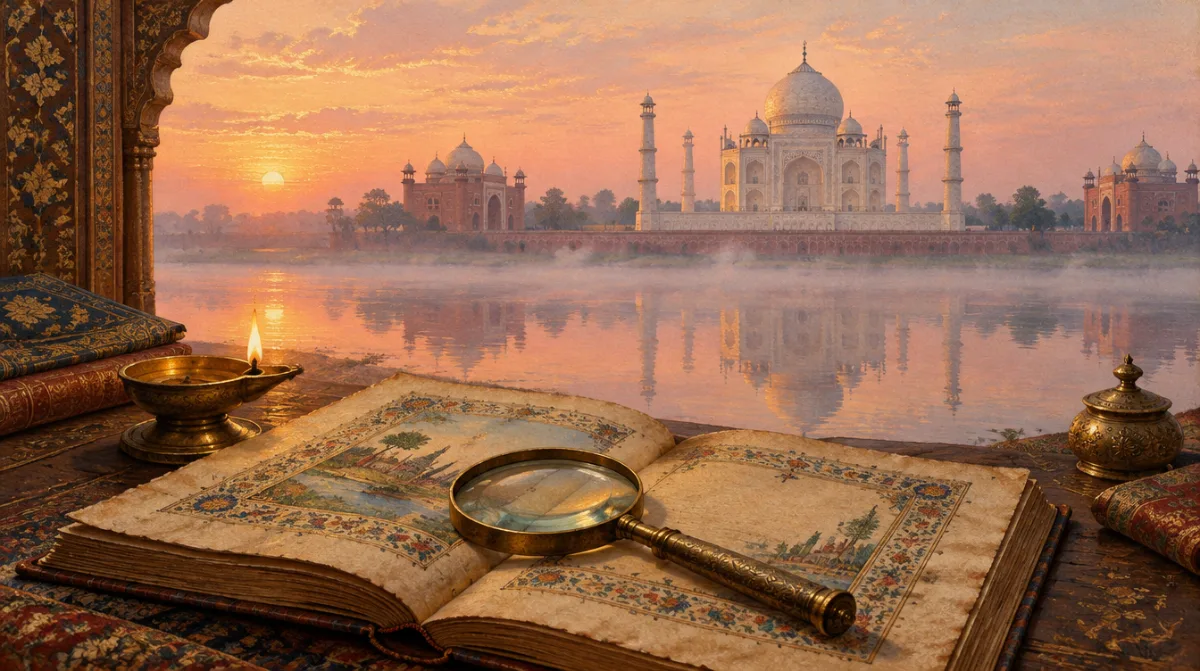
The real story behind the Taj Mahal is well documented: it is the tomb Emperor Shah Jahan built for his wife Mumtaz Mahal after she died in 1631, designed under the architect Ustad Ahmad Lahori and finished, with its gateway, mosque and gardens, by 1653. Around that story a lot of myths have grown: a secret temple, 22 hidden rooms, craftsmen with their hands cut off, a black twin across the river. Your guide will hear these questions every day at the gate. Here is what the records actually say, myth by myth, with sources.
Want the story told where it happened? On our private Taj Mahal tours from Delhi, your own guide walks you through the gateway, the garden, the crypt and the Agra Fort tower where Shah Jahan spent his last years. See the tours →
For the full love story of Shah Jahan and Mumtaz Mahal, from their betrothal to her death in Burhanpur, read Shah Jahan and Mumtaz Mahal: the real story behind the Taj Mahal. This post is about the myths.
The Taj Mahal in one paragraph
Mumtaz Mahal died on 17 June 1631 in Burhanpur while giving birth to her fourteenth child. Shah Jahan began her tomb in Agra, on the bank of the Yamuna, in 1632. UNESCO's World Heritage listing records that the mausoleum was finished in 1648 and the mosque, guest house, main gateway and outer courtyard by 1653. Shah Jahan was deposed by his son Aurangzeb in 1658, held in the Agra Fort, and buried beside his wife in 1666. Mughal court histories called the building the Rauza-i-Munavvara, the "illumined tomb".
Myth 1: "The Taj Mahal was a Hindu temple called Tejo Mahalaya"
What the record says: The idea that the Taj Mahal was originally a Shiva temple has circulated for decades and has been raised in court several times. In 2017 the Archaeological Survey of India (ASI), which manages the monument, told a court in Agra that the Taj Mahal is a tomb and that there is no evidence of a temple at the site (Times of India). In May 2022 the Allahabad High Court dismissed a petition asking for a "fact-finding committee" on the monument's history, saying such questions belong to historians, not courts (Indian Express).
The short answer: The documented history, the Mughal court records and the ASI all describe a 17th-century Mughal tomb.
Myth 2: "The 22 locked rooms hide a secret"
What the record says: The "22 rooms" are a row of arched cells along a corridor in the lower levels of the riverside platform. They are maintained by the ASI and kept closed to visitors for safety and crowd management. When the Allahabad High Court dismissed the 2022 petition to open them, the ASI's account, reported by the Indian Express, was that nothing of significance is inside, and photographs of conservation work in the cells were published at the time.
The short answer: Locked does not mean secret. Many monuments keep service areas closed.
Myth 3: "Shah Jahan cut off the craftsmen's hands"
What the record says: No contemporary source records it. The story, that the emperor maimed the builders so they could never build anything as beautiful again, is a folk tale told about several famous buildings around the world. The same families of inlay workers continued their craft in Agra, and you can still watch marble inlay being made in workshops in the city today.
The short answer: A legend with no evidence behind it.
Myth 4: "Shah Jahan planned a Black Taj Mahal across the river"
What the record says: The idea of a matching tomb in black marble for Shah Jahan, opposite the Taj, comes from a 17th-century traveller's account and has never been backed by evidence. The site across the river is Mehtab Bagh, a Mughal moonlight garden aligned with the Taj Mahal. It is the best place to see the monument at sunset.
The short answer: Mehtab Bagh is real; the Black Taj is not.
Myth 5: "20,000 workers built it in 22 years"
What the record says: This one is broadly true. Britannica puts the workforce at more than 20,000 and the building time at a little over two decades for the whole complex (Britannica). Masons, inlayers, calligraphers and dome builders came from across the Mughal Empire, Central Asia and Iran.
The short answer: True, with the caveat that the tomb itself was finished in about 16 years and the full complex in about 21.
Myth 6: "It cost 32 million rupees"
What the record says: That figure is the estimate usually quoted from the period. Converting a 17th-century cost into today's money is guesswork, so be wary of any precise dollar figure you see online.
The short answer: The 32 million rupee figure is a historical estimate; modern conversions are not reliable.
Myth 7: "The minarets lean outward so they would fall away in an earthquake"
What the record says: The four minarets do stand very slightly off vertical, and the explanation most often given is that they would fall away from the tomb rather than onto it. It is a sensible idea, but no Mughal document states that this was the builders' intention.
The short answer: A popular explanation, not a documented one.
Myth 8: "Mumtaz Mahal and Shah Jahan lie in the main hall"
What the record says: The two marble cenotaphs you see inside the main chamber are symbolic. The real graves are in the crypt directly below, a common arrangement in imperial Mughal tombs.
The short answer: You are looking at memorials, not graves.
Myth 9: "The Taj Mahal is perfectly symmetrical"
What the record says: Almost. The whole complex is laid out in mirror image, with a red sandstone mosque on one side matched by a guest house on the other. The single exception is Shah Jahan's own cenotaph. It was placed beside his wife's after his death in 1666, and it is larger than hers, so it sits off the central axis.
The short answer: Symmetrical, apart from the emperor himself.
Myth 10: "It was built only for love"
What the record says: Grief was the reason, but not the only message. The tomb stands at the end of a four-part charbagh garden meant to evoke the gardens of paradise, and its scale and white marble announced the wealth of the Mughal Empire at its height. It is a love story and a statement of power at the same time.
The short answer: Both love and empire.
How to see the real story in Agra
The story makes most sense in this order:
- The Taj Mahal, for the gateway, the garden, the calligraphy and the cenotaphs. Ask your guide to show you where the real graves lie.
- The Agra Fort, for the Musamman Burj, the marble tower where Shah Jahan is said to have spent his last years looking at the Taj.
- Mehtab Bagh, for the "Black Taj" site and the sunset view across the river.
- Itimad-ud-Daulah, the "Baby Taj", the tomb of Mumtaz Mahal's grandfather, with the marble inlay that came before the Taj.
The Taj Mahal is closed on Fridays. It opens 30 minutes before sunrise and closes 30 minutes before sunset. Current entry fees are in our Taj Mahal ticket price guide, and the best time to visit guide covers the seasons.
Coming from Delhi? A same-day Agra tour by car covers the Taj Mahal and the Agra Fort with your own guide, and the sunrise tour gets you in with the softest light and the smallest crowds.
Frequently asked questions
What is the real story behind the Taj Mahal? It is the tomb Emperor Shah Jahan built for his wife Mumtaz Mahal, who died in 1631. Construction began in 1632 and the complex was finished by 1653.
Was the Taj Mahal a temple? No evidence supports it. The Archaeological Survey of India told a court in 2017 that it is a tomb, and the Allahabad High Court dismissed a 2022 petition on the question.
What is inside the 22 locked rooms? They are arched cells along a corridor in the platform, maintained by the ASI and closed for safety. Nothing of significance has been reported inside.
Did Shah Jahan cut off the workers' hands? No. There is no historical record of it; it is a legend.
Is the Black Taj Mahal real? No. The site across the river is the Mehtab Bagh garden.
Who is buried in the Taj Mahal? Mumtaz Mahal and Shah Jahan, in the crypt beneath the cenotaphs in the main chamber.
Sources
Dates and architecture: the UNESCO World Heritage listing for the Taj Mahal and Britannica. Court statements: Times of India, 2017 and Indian Express, 2022. Where a claim is a legend or an unproven explanation, we say so above.
More from the blog
- Did Shah Jahan Build the Taj Mahal After Mumtaz's Death? Yes: Mumtaz Mahal died in 1631 and the Taj Mahal was begun in 1632. The full timeline, from her first grave in Burhanpur to the finished tomb in 1653.
- Agra Travel Glossary: 40 Terms to Know Before You Go A plain-English Agra travel glossary: 40 terms, places and rules, from Taj Mahal tickets and Friday closures to UNESCO sites, trains and food.
- Diwali and the Taj Mahal: Festivals and Crowds in Agra Visiting the Taj Mahal around Diwali 2026: dates, whether it is open, crowd and smog patterns, other Agra festivals, and how to plan around them.
Keep reading
- How to Avoid Taj Mahal Scams (2026) The scams that catch visitors between Delhi and the Taj Mahal, from fake ticket sites to 'skip the line' guides, and how to check any operator.
- Taj Mahal Opening Hours and Friday Closure The Taj Mahal opens 30 minutes before sunrise and is closed every Friday. Opening times by month, ticket counters and gates, from ASI's own page.
- Delhi to Agra in a Day: Car or Train? Delhi to Agra in one day: by car (about 3 hours each way) or the Gatimaan Express (1 hr 40 min)? Times, costs and trade-offs compared.