
Top Taj Mahal Tour Packages from Delhi
By IWIS Global · Published 6 October 2026 · Updated 12 October 2026
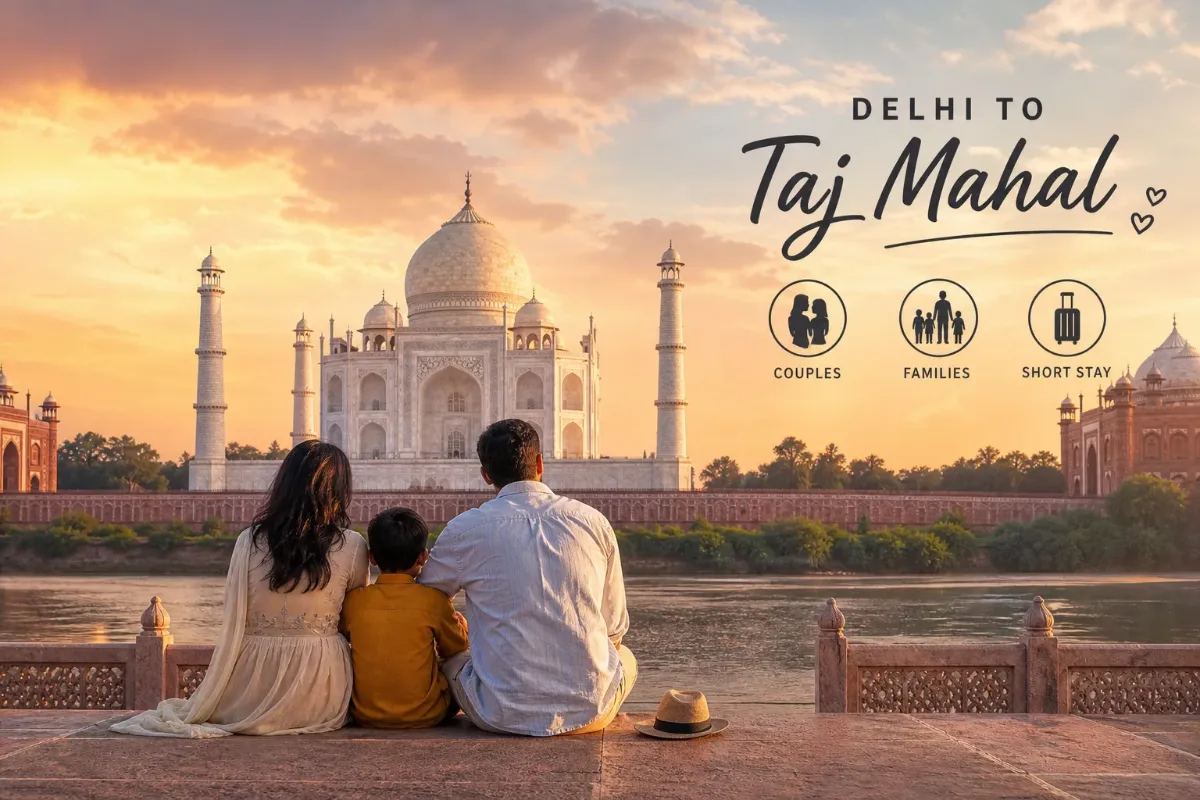
Choosing the right Taj Mahal tour package from Delhi is straightforward in principle but genuinely confusing in practice. The Taj Mahal sits about 230 km by road from Delhi, roughly three to four hours via the Yamuna Expressway, which sounds manageable until you start comparing listings. Same-day car tours, Gatimaan Express deals, sunrise visits, luxury overnight options, Golden Triangle combinations: every format promises the definitive experience, and most listings look nearly identical at first glance. Without a clear framework for comparison, it's easy to pay for the wrong thing, a shared bus when you wanted privacy, a train package when you needed a car, or a price that looks sharp until the entry tickets and guide fees arrive separately.
This guide breaks down each Taj Mahal tour package type honestly so you can match the right one to your group, your schedule, and your budget before you commit. The right choice depends on who you're travelling with, how much time you have, and what you want to spend, and those three variables point to very different formats. (This guide is for couples, families and short-stay travellers.)
Which Taj Mahal tour package format suits your group and schedule
Same-day car tour: the most flexible choice for families
A private car tour from Delhi is a widely favoured format, and for understandable reasons. It starts at your hotel door, runs at your own pace, and leaves room for stops at Agra Fort, Mehtab Bagh, or a proper sit-down lunch without a fixed timetable dictating when you move. Families with young children, travellers who dislike fixed group schedules, and anyone who wants the option to linger or skip a stop benefit most from this structure. The trade-off is time: the Yamuna Expressway journey is three to four hours each way, making this a 12 to 14-hour day in total.
Gatimaan Express package: built for time-tight visitors
The Gatimaan Express runs from Hazrat Nizamuddin to Agra Cantt in about 1 hour 40 minutes, departing at 08:10 and arriving at 09:50. For business travellers and short-stay visitors with exactly one free day in Delhi, this is the fastest realistic option. Train packages typically include station transfers, a guide at the Agra end, and sometimes a pre-arranged lunch, though inclusions vary by operator, so confirm on the product page before booking. The overall effect is a compact, predictable day with minimal logistical decisions to make on the ground. See our Gatimaan Express tour and the train timetable and booking guide.
Taj Mahal sunrise tour: the obvious choice for couples and photographers
Arriving at the Taj Mahal within the first 30 to 45 minutes after the gates open means thinner crowds, softer light, and dramatically better photographs. The price is an early hotel departure, often by 5:30 a.m., and many visitors find it thoroughly worthwhile. One practical note: winter fog in January and February can reduce visibility significantly on early mornings, so late autumn and early spring offer the most reliable conditions for a sunrise visit. See our sunrise tour and whether it is worth the early start.
Overnight and luxury packages: when one day isn't enough
Honeymooners and luxury travellers often prefer to stay one night in Agra, visiting the Taj Mahal at both sunrise and in the softer late-afternoon light. Overnight packages typically include a 3 to 5-star hotel in Agra, two monument visits, and a more relaxed overall pace with no long return drive on the same evening. The Golden Triangle tour package extends this further by adding Jaipur, making it the natural fit for first-time visitors to India who want to cover three of the country's most iconic destinations in one well-organised itinerary.
What the price covers and what operators often leave out
Typical cost ranges from budget to luxury
For a same-day Agra tour package, per-person prices run from roughly ₹3,000 to ₹17,000 or more depending on the vehicle grade, inclusions, and group size. Overnight packages start at around ₹6,000 and reach ₹34,000 for premium options, while dedicated luxury packages with five-star hotels, private guides, and curated meals typically range from ₹8,500 to ₹42,000 per person. Solo travellers consistently pay the highest per-person rate on private tours because vehicle and guide costs are fixed regardless of group size; for groups of four or more, the per-person cost drops considerably.
What's usually included and what commonly isn't
Most private Taj Mahal packages from Delhi include the vehicle, the driver, and hotel pickup as a baseline. What they frequently omit: entry tickets to the Taj Mahal and Agra Fort, guide fees, meals, parking and toll charges, and GST. These five items are often listed as "not included" even in mid-range packages. A quote that looks ₹2,000 cheaper than another may flip in real value once you factor in a private guide (typically around ₹1,500) and foreign tourist entry, ₹1,100 for complex access plus ₹200 for the mausoleum. Always ask for a written breakdown before comparing two quotes side by side.
What a well-organised same-day Taj Mahal tour itinerary looks like
Hour-by-hour: a sample private car tour from Delhi
A well-structured same-day private car tour typically begins with hotel pickup between 5:30 and 6:00 a.m. from anywhere in Delhi, with the drive covering the Yamuna Expressway to reach Agra by 9:00 to 9:30 a.m. The Taj Mahal visit runs from roughly 9:30 a.m. to noon with a dedicated English-speaking guide exclusive to your group throughout. After lunch at a recommended restaurant, the afternoon covers Agra Fort from 2:00 to 3:30 p.m., with an optional stop at Mehtab Bagh for the rear-facade view across the Yamuna, before the return drive brings you back to Delhi by 8:00 to 9:00 p.m.
The practical advantage of a private format is what it removes: no shared-bus component, no waiting for other guests to finish at a site. That said, always request a written inclusions list from your operator and confirm that the price quoted at booking is the final price, inclusions and terms do vary, and a brief check saves complications on the day.
Car vs train: which actually saves time
The Gatimaan train journey is 1 hour 40 minutes, but the total time picture is different. Add station arrival time in Delhi, a transfer from Agra Cantt to the monument area, and the fixed return schedule (the train departs Agra at 17:35 on the timetables we checked, and some operators list 17:50), and the real time advantage over a car on a clear day narrows to about 60 to 90 minutes. The car is slower, but it covers more of Agra and removes station logistics entirely. For anyone adding Fatehpur Sikri to the itinerary, the car is the only practical option; the train locks you into a fixed departure time that won't accommodate a third stop.
On-the-ground details that shape the visit
Tickets, timing and the Friday closure
The Taj Mahal is open Saturday through Thursday, from 30 minutes before sunrise to 30 minutes before sunset. It is closed every Friday without exception. For a sunrise visit, the standard advice is to arrive at the East Gate 45 to 60 minutes before sunrise, as queues form quickly after the gates open. Online tickets are sold through the Archaeological Survey of India's official portal (asi.paygov.org.in); booking ahead is strongly recommended for a sunrise visit because it avoids the counter queue. Mausoleum access, entry to the inner tomb chamber, is a separate ₹200 ticket on top of standard complex admission and is worth adding if you're making the journey. Our ticket price guide explains which ticket you need.
Ticket prices in 2026 for foreign tourists are ₹1,100 for complex entry plus ₹200 for the mausoleum, totalling ₹1,300 per adult. Indian nationals pay ₹50 for complex entry with the same ₹200 mausoleum fee. Children under 15 generally enter free, and online bookings receive a small discount per ticket.
Best photo spots and what to pack
The classic reflection shot is taken from the central pathway facing the main gate, roughly one-third of the way from the entrance arch; arrive early before the pool area gets crowded. For a less-visited viewpoint, Mehtab Bagh across the Yamuna River offers a full rear-facade view that many visitors overlook entirely.
On packing: bring thick socks, as you'll remove your shoes before stepping onto the marble platform, and sun-heated marble in May or cold marble on a February morning both make the right footwear relevant. Carry only a small bag, as large bags require a cloakroom deposit. A number of items, drones, tripods, and selfie sticks among them, are prohibited inside the complex (see our list of things not to bring). Dress in breathable layers regardless of season, because the temperature differential between the car, the open grounds, and the shaded inner chambers can be considerable. Modest clothing covering shoulders and knees is appropriate and advisable.
How to compare Taj Mahal tour packages and book without second-guessing yourself
Reading the inclusions list before you pay
Run through five items on every package listing before you compare prices: vehicle and driver, guide (confirm whether private or shared), entry tickets, meals, and hotel pickup. Any package that leaves more than two of these vague in the listing description warrants a direct query before payment. Operators with transparent, itemised pricing remove this back-and-forth entirely because the breakdown is visible at the point of booking, a meaningful time-saver when you're planning across multiple cities and options.
Cancellation policies and last-minute booking
The industry standard for Agra day trip packages is free cancellation and a full refund when cancelled at least 24 hours before the local start time. Some multi-day and train-based packages apply a longer cutoff, sometimes four full days, so the specific booking page terms matter more than any general policy pattern. For travellers with unpredictable Delhi schedules, particularly business visitors whose stays can extend or shorten at short notice, operators that accept bookings up to the night before departure offer a practical advantage worth factoring into the decision. Confirm the exact booking window and cancellation terms directly with your chosen operator before paying.
Choosing the right Taj Mahal tour package before you commit
The decision is straightforward once the formats are clear. A same-day private car Taj Mahal tour package suits most first-time visitors and families because it offers flexibility, hotel-to-hotel service, and the ability to cover multiple Agra sites at your own pace. The Gatimaan Express package suits time-constrained travellers who want a compact, predictable day and are comfortable with a fixed return schedule. A sunrise tour is worth the early start for couples and serious photographers, particularly in autumn and early spring when morning conditions are most reliable. An overnight or Golden Triangle package is the right call for honeymooners and first-time India visitors who want depth, not just speed.
The gap between a well-organised private Taj Mahal visit and a stressful, piecemeal one comes down to what's confirmed in writing before you depart: vehicle, guide, tickets, hotel pickup, and the final price. Operators who present all of this upfront, accommodate late bookings, and offer clear cancellation terms remove most of the risk from the decision. That clarity is worth more than any headline price difference.
IWIS Global runs private same-day Taj Mahal tours from Delhi: by car or by Gatimaan Express train, plus a sunrise tour and a luxury car tour. Each is for your group only, with Delhi hotel pickup, a private English-speaking guide, fixed prices shown before you pay, and no commission from any shop or stop. You can book until 9 PM IST the night before, with a full refund if you cancel at least 24 hours ahead. We also run private 3 day, 4 day and 5 day Golden Triangle tours with hotels included, and an Agra overnight tour. If you stay in Agra, see our guide to choosing an Agra holiday package, or contact the IWIS Global team to check availability and match your group to the right format and date.
More from the blog
- Did Shah Jahan Build the Taj Mahal After Mumtaz's Death? Yes: Mumtaz Mahal died in 1631 and the Taj Mahal was begun in 1632. The full timeline, from her first grave in Burhanpur to the finished tomb in 1653.
- What Is the Real Story Behind the Taj Mahal? 10 Myths vs Facts The real story behind the Taj Mahal, myth by myth: the temple claim, the 22 locked rooms, the Black Taj, the craftsmen's hands and more, checked against the records.
- Agra Travel Glossary: 40 Terms to Know Before You Go A plain-English Agra travel glossary: 40 terms, places and rules, from Taj Mahal tickets and Friday closures to UNESCO sites, trains and food.
Keep reading
- How to Avoid Taj Mahal Scams (2026) The scams that catch visitors between Delhi and the Taj Mahal, from fake ticket sites to 'skip the line' guides, and how to check any operator.
- Best Month to Visit the Taj Mahal November through February is coolest, but not always clearest. Month-by-month temperature, pollution pattern, and sunrise timing — not just 'winter is best.'
- Taj Mahal Opening Hours and Friday Closure The Taj Mahal opens 30 minutes before sunrise and is closed every Friday. Opening times by month, ticket counters and gates, from ASI's own page.