
Diwali and the Taj Mahal: Festivals and Crowds in Agra
By IWIS Global · Published 17 October 2026
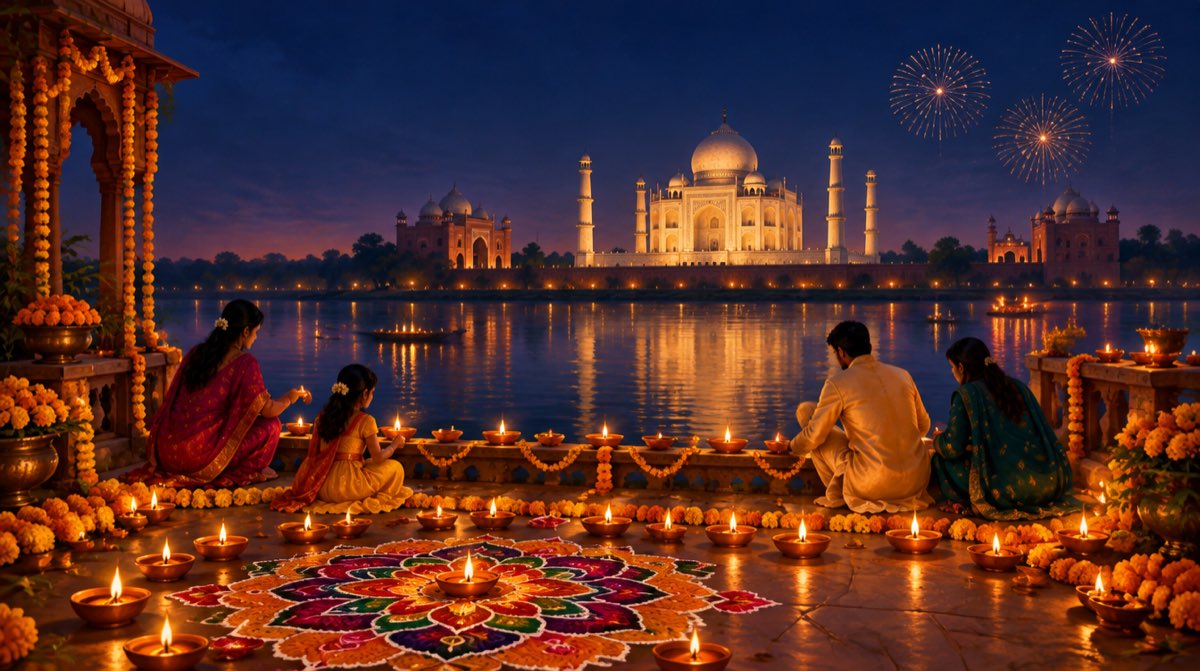
You can visit the Taj Mahal during Diwali, but expect crowds, and plan around the dates. Diwali 2026 falls on Sunday 8 November, and the five-day festival runs from about 6 to 11 November. The Taj Mahal closes only on Fridays, so it is open on Diwali itself, but holiday weekends bring far more Indian visitors, the nights are dark (Diwali is a new moon, so there is no moonlit night viewing), and smog after the fireworks can hide the monument. This guide covers the Diwali dates, how crowded Agra gets, the other festivals that change a visit (Dussehra, the Urs of Shah Jahan, Taj Mahotsav and Holi), and how to plan so you still see the Taj Mahal well.
Diwali 2026 at a glance
| Diwali (Lakshmi Puja) | Sunday, 8 November 2026 |
| Festival runs | About 6 to 11 November: Dhanteras on Friday 6 November, Choti Diwali on 7 November, Diwali on 8 November, then Govardhan Puja and Bhai Dooj in the days after (calendars differ by a day) |
| Taj Mahal on Diwali | Open, as it is every day except Friday. Hours run from 30 minutes before sunrise to 30 minutes before sunset |
| Taj Mahal on Friday 6 November | Closed (Dhanteras falls on a Friday this year) |
| Agra Fort | Open every day, including Fridays |
| Night viewing | Not available around Diwali: it is a new-moon festival, and night viewing runs only around the full moon |
| Biggest risks | Crowds, hotel and traffic pressure, and post-fireworks smog |
Is the Taj Mahal open on Diwali?
Yes. The Archaeological Survey of India (ASI) states that the Taj Mahal is open every day except Friday, from 30 minutes before sunrise to 30 minutes before sunset, and Diwali is not listed as a closure. In 2026 that means:
- Friday 6 November (Dhanteras): closed, as on every Friday.
- Saturday 7 November, Sunday 8 November and the following days: open.
Opening arrangements can change, so check the ASI's notices at tajmahal.gov.in in the week you travel. If you are in Agra on the Friday, Agra Fort is open and makes a good alternative.
How crowded is the Taj Mahal during Diwali?
Busy. Travel writers consistently list Diwali and other Indian holidays among the most crowded times. One well-known insider guide reports roughly 52,000 visitors a day on weekends and national holidays, more than four times a typical weekday. That is that guide's figure, not an ASI count, but the pattern is real: festivals bring domestic visitors on holiday, and the Taj Mahal is a top family outing.
What makes Diwali 2026 busier: it falls on a Sunday, the festival week includes a weekend either side, and many Indian families travel during the holiday. Expect queues at the gates and security checks, and more people at the main platform and the photo spots.
How to beat the crowds:
- Go early. ASI's own visitor FAQ says that visiting early lets you avoid the crowds, and that sunset usually has more people than sunrise. A sunrise visit to the Taj Mahal is the best way to see it quietly.
- Choose a weekday. If your dates are flexible, a mid-week morning outside the holiday days is calmer than the weekend of Diwali.
- Avoid the middle of the day. Midday is hot, bright and crowded.
- Have a plan for the afternoon. Spend it at Agra Fort, Itimad-ud-Daulah or Mehtab Bagh, where the crowds are thinner, and see the Taj Mahal from across the river at sunset.
- Book early. Guides, drivers and hotels fill up around Diwali. Book your tour and your stay well before the festival week.
Smog after Diwali: what to expect
Diwali nights in North India bring fireworks, and late October to November is also when air quality is often poor. After past Diwali nights, thick smog has blanketed Agra and hidden the Taj Mahal: the Times of India reported the monument "disappearing" in the haze, with the air quality index in the "severe" band above 400. It does not happen every year, and it depends on the weather, but it is a real risk around Diwali.
What to do:
- Check the air quality forecast a few days before, and again the evening before your visit.
- Allow flexibility. If the morning after Diwali looks smoggy, swap your Taj Mahal visit to a clearer day, and use the smoggy morning for indoor stops or the Agra Fort.
- Consider a mask if you are sensitive to polluted air.
- For a second chance at clear views, read our guide to the best time to visit the Taj Mahal for the weather month by month.
Night viewing and Diwali: why the dark night does not help
Diwali falls on the new moon, the darkest night of the month. The Taj Mahal's night viewing is only allowed on the full-moon night and the two nights either side, never on a Friday, and not during Ramzan. That means:
- There is no night viewing around Diwali.
- If you want the moonlit Taj Mahal this autumn, the next windows in ASI's 2026-27 schedule are around the full moons of 26 October (24 to 28 October) and 24 November (22 to 26 November), then 23 December and 22 January 2027.
If a moonlit visit matters to you, see our Taj Mahal moonlight night viewing tour for the bookable dates.
Diwali in Agra: what the city feels like
Away from the monuments, Agra celebrates like the rest of North India. Homes and shops are lit with oil lamps (diyas) and string lights, markets sell sweets, decorations and lamps, families pray in the evening on Lakshmi Puja, and fireworks go off late into the night. A few practical points:
- Some shops and restaurants close or shorten their hours on Diwali day and evening, so confirm before you plan a dinner.
- Expect noise and fireworks in the evening, especially in the old city. Light sleepers should ask for a quieter room.
- Sweets are everywhere. It is a good time to try Agra's famous petha and other festival sweets. See our guide to what to eat in Agra, and remember that food is not allowed inside the Taj Mahal.
- Roads are busier around the holiday. The drive from Delhi on the Yamuna Expressway can take longer around festival weekends, so leave earlier than usual.
Other festivals that change a visit to Agra
| Festival | When | What it means for your visit |
|---|---|---|
| Dussehra and Ramlila | Second half of October | Ramlila performances and Dussehra events around the city; busier evenings |
| Diwali | 8 November 2026 | Holiday crowds, fireworks, smog risk |
| Urs of Shah Jahan | January, dates shift each year with the Islamic calendar (15 to 17 January in 2026) | Special free-entry arrangements and very large crowds |
| Taj Mahotsav | Ten days in February at Shilpgram, Fatehabad Road (18 to 27 February in 2026) | A fair of crafts, food and culture; traffic and hotel demand |
| Holi | March, around 22 to 23 March 2027 | Colours in the streets; the biggest Holi celebrations are in nearby Mathura and Vrindavan |
| Christmas and New Year | Late December to early January | Heavy domestic and international crowds |
The Urs in more detail. Each year the Taj Mahal marks the death anniversary of Shah Jahan with the Urs, a three-day religious observance. In January 2026 it ran from 15 to 17 January, as Shah Jahan's 371st Urs, with special free-entry arrangements. Free entry draws very large crowds, so the Urs is not the day for a quiet visit. The dates follow the Islamic lunar calendar, so they move earlier each year, and the entry hours are announced by the ASI.
Taj Mahotsav. This ten-day annual festival of arts, crafts and food is held each February at Shilpgram near the Taj Mahal. It adds to hotel demand and road traffic in the city, so book ahead if your trip overlaps.
Holi. Holi is celebrated in March. Mathura and Vrindavan, close to Agra, are especially famous for it. If you are in Agra at Holi, expect coloured powder in the streets: protect cameras, phones and your clothes, and check the ASI's notices for the Taj Mahal and Agra Fort.
How to plan a Diwali trip to Agra
- Pick your day. If you can, avoid Friday 6 November (the Taj Mahal is closed) and Diwali weekend itself. A weekday before or after the festival week is the quietest option.
- Start at sunrise. Enter as early as you can, and finish the Taj Mahal before the crowds peak.
- Spend the afternoon elsewhere. Visit Agra Fort, Itimad-ud-Daulah and Mehtab Bagh, and plan a sunset view from across the river.
- Keep a backup day. If smog hides the monument, shift the Taj Mahal visit by a day.
- Book early. Reserve your guide, car or train tour and your hotel well in advance.
Our tours: the same-day Agra tour from Delhi, the Taj Mahal sunrise tour, the Agra private sightseeing tour, and the Gatimaan Express day tour. Check availability for your dates on each tour page, or see all options on the tours page. If you are deciding how long to stay, our guide on whether one day is enough can help, and the story behind the monument is in Shah Jahan and Mumtaz Mahal: the real story behind the Taj Mahal.
FAQs about Diwali and the Taj Mahal
When is Diwali in 2026? Diwali (Lakshmi Puja) is on Sunday, 8 November 2026. The festival runs from Dhanteras on 6 November to Bhai Dooj a few days after Diwali.
Is the Taj Mahal open on Diwali? Yes. The Taj Mahal is open every day except Friday, and Diwali is not a listed closure. Check the ASI's notices in the week you travel.
Is the Taj Mahal closed on Friday 6 November 2026? Yes. It is closed every Friday, and Dhanteras falls on a Friday this year.
Is the Taj Mahal crowded during Diwali? Yes. Holidays and weekends are the busiest times. Go at sunrise, choose a weekday if you can, and avoid the middle of the day.
Can I see the Taj Mahal at night during Diwali? No. Night viewing is only allowed around the full moon, and Diwali falls on the new moon.
Will smog hide the Taj Mahal after Diwali? It can. After past Diwali nights, thick smog has hidden the monument. Check the air quality forecast and keep a backup day.
Is Agra Fort open on Diwali? Agra Fort is open every day, including Fridays. Confirm on the day, as holiday arrangements can change.
What is the Urs of Shah Jahan? The annual three-day observance of Shah Jahan's death anniversary at the Taj Mahal. In 2026 it ran from 15 to 17 January, with special free-entry arrangements and very large crowds.
When is Taj Mahotsav? A ten-day festival each February at Shilpgram, Agra. In 2026 it ran from 18 to 27 February.
What is the best time to visit the Taj Mahal to avoid crowds? Early morning on a weekday outside holidays. See our guide to the best time to visit the Taj Mahal.
Sources
Diwali 2026 dates are from Drik Panchang's Diwali calendar and other panchang sources; calendars can differ by a day. Opening days and hours are from the Taj Mahal official website and its FAQs. Night-viewing nights are from the ASI's night-view notice. The 2026 Urs dates are from NDTV's report. Taj Mahotsav details are from the official Taj Mahotsav site and Incredible India. Post-Diwali smog is reported by the Times of India. Holiday crowd levels come from Wendy Perrin's Agra guide. Festival dates and ASI arrangements can change, so confirm them before you travel.
More from the blog
- Did Shah Jahan Build the Taj Mahal After Mumtaz's Death? Yes: Mumtaz Mahal died in 1631 and the Taj Mahal was begun in 1632. The full timeline, from her first grave in Burhanpur to the finished tomb in 1653.
- What Is the Real Story Behind the Taj Mahal? 10 Myths vs Facts The real story behind the Taj Mahal, myth by myth: the temple claim, the 22 locked rooms, the Black Taj, the craftsmen's hands and more, checked against the records.
- Agra Travel Glossary: 40 Terms to Know Before You Go A plain-English Agra travel glossary: 40 terms, places and rules, from Taj Mahal tickets and Friday closures to UNESCO sites, trains and food.
Keep reading
- Taj Mahal Ticket Price 2026: The Full Cost Taj Mahal tickets: foreign entry is ₹1,100, but most guides leave out the ₹200 mausoleum ticket. The full cost stack, sourced from ASI's own ticketing page.
- How to Avoid Taj Mahal Scams (2026) The scams that catch visitors between Delhi and the Taj Mahal, from fake ticket sites to 'skip the line' guides, and how to check any operator.
- Taj Mahal Opening Hours and Friday Closure The Taj Mahal opens 30 minutes before sunrise and is closed every Friday. Opening times by month, ticket counters and gates, from ASI's own page.